
Architectural Fixed Fee vs Hourly Rates 2026
Table of Contents
- Fixed Fee vs Hourly Rates: A Direct Comparison
- Advantages and Disadvantages of Fixed Fee Pricing
- Advantages and Disadvantages of Hourly Rate Pricing
- Architect Fee Percentage of Construction Cost Explained
- What Is Included in Architect Fees (and What Is Not)
- How to Negotiate Architect Fees Without Cutting Quality
- Factors Influencing Architect Fees in 2026
- Conclusion
- Frequently Asked Questions
Last Updated: 23 September 2026
Fixed Fee vs Hourly Rates: A Direct Comparison
Choosing between a fixed fee and hourly rates is the first real financial decision in any building project, and architectural fixed fee vs hourly rates 2026 is the comparison that decides it. Architectural fixed fee vs hourly rates 2026 comes down to one question: who carries the risk of the project taking longer than expected? With a fixed fee, the architect does. With hourly rates, you do. This guide from MB Architecture breaks down both models, what sits inside architect fees, and how to negotiate without sacrificing design quality.
A fixed fee is a single, agreed price for a defined scope of work, such as RIBA Stages 0-4. An hourly rate is a charge for every hour the practice spends on your project, billed at an agreed rate.
The RIBA Plan of Work sets out the stages that both models should reference, so you can compare proposals on equal terms. Without a defined scope, neither model protects you.
|
Feature |
Fixed Fee |
Hourly Rates |
|---|---|---|
|
Cost certainty |
High |
Low |
|
Risk of overrun |
Architect carries it |
You carry it |
|
Best for |
Clear, defined briefs |
Evolving or uncertain briefs |
|
Scope changes |
Priced as variations |
Billed as extra hours |
|
Admin burden |
Low |
Higher, with time records |
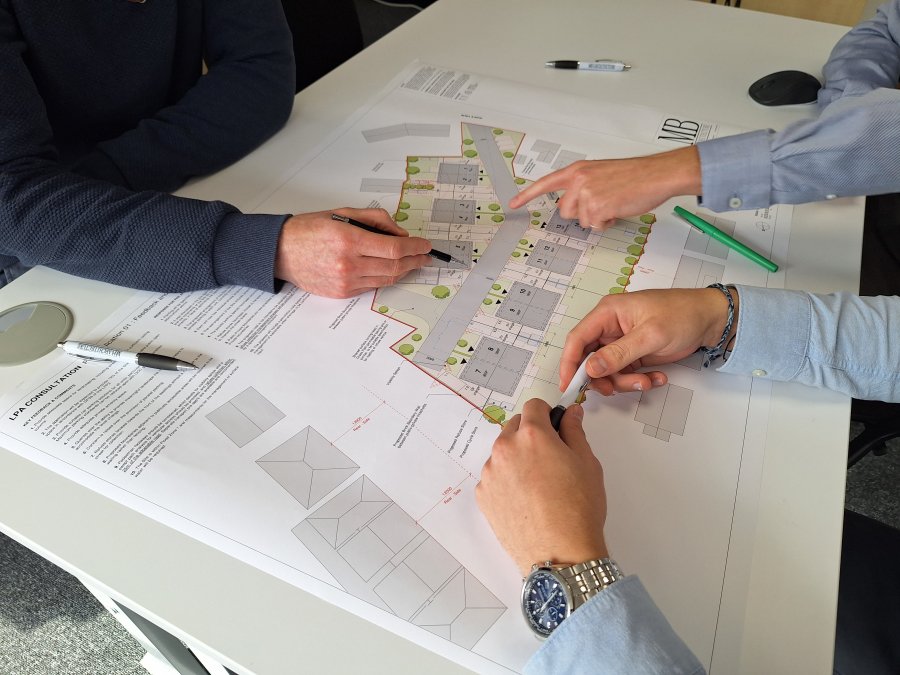
Three architects at a white desk reviewing architectural drawings spread out in a bright studio office.
Advantages and Disadvantages of Fixed Fee Pricing
The main advantage of a fixed fee is budget certainty. You know the cost of each stage before work begins, which makes it far easier to fund a project and compare quotes properly.
The trade-offs are real, though. A fixed fee only covers the agreed scope, so changes to the brief are usually priced separately. Some practices also build a contingency into the fee to cover their own risk, which can make the headline figure look higher than an hourly estimate.
- Advantage: predictable cost for budgeting and lender discussions
- Advantage: no need to track or query timesheets
- Disadvantage: variations to scope are charged on top
- Disadvantage: a conservative quote may include a risk buffer
For developers, contractors and self builders with a settled brief, the certainty usually outweighs the premium.
Advantages and Disadvantages of Hourly Rate Pricing
Hourly billing suits projects where the brief is still developing. You pay for the work actually done, which can mean a lower total cost when a project runs smoothly and stays within scope.
The catch is that the final bill is unknown at the outset. Planning queries, design revisions and consultant coordination all add hours, and those hours add cost. A common mistake is comparing an hourly estimate with a fixed quote as if they were the same thing. They are not.
- Advantage: you pay only for work carried out
- Advantage: flexible when the brief changes often
- Disadvantage: no guaranteed ceiling on total cost
- Disadvantage: requires clear time records and regular review
Architect Fee Percentage of Construction Cost Explained
The architect fee percentage of construction cost is a third model, where the fee is calculated as a percentage of the build cost. For new build projects it typically sits between 5% and 12% depending on project complexity and the stages covered, though the exact figure should always be confirmed in the fee proposal.
This approach scales with the project, so a larger build carries a larger fee. It works well when the construction budget is clear, and as the scope and budget increase, the fee rises to cover that increase in architectural work.
What Is Included in Architect Fees (and What Is Not)
What is included in architect fees varies by practice, which is why you should compare proposals line by line rather than on the headline number. Most fees cover design development, planning drawings, and coordination with consultants.
Typically included:
- Initial concept design and feasibility advice
- Planning application drawings and submission support
- Building Regulations drawings and technical details
- Coordination with structural and other consultants
Usually excluded:
Contact MB Architecture to obtain free advice and get a quote →
- Planning application fees paid to the local authority
- Structural engineer and surveyor fees
- Party wall agreements and specialist reports
- Site inspections and contract administration, unless stated
How to Negotiate Architect Fees Without Cutting Quality
How to negotiate architect fees well means adjusting scope, not squeezing the rate. Cutting the fee too hard pushes practices to reduce the time spent on design, and that shows up later in planning delays and costly revisions.
A practical approach:
- Ask for a staged fee proposal so you can see the cost of each RIBA stage or work stage
- Agree a clear scope in writing, including the number of design revisions
- Fix the fee for the defined scope and price variations separately
- Confirm what is excluded so no surprises appear mid-project
- Check the practice is insured before appointing
MB Architecture prices the majority of its projects on a fixed fee, which removes the guesswork from the process and keeps the budget predictable. We also hold high levels of PI insurance.
Factors Influencing Architect Fees in 2026
Several pressures are shaping fees this year. Planning authorities are asking for more detail at submission stage, particularly around sustainability and drainage, which adds design time. Building safety requirements continue to raise the technical workload on larger schemes.
Project complexity remains the biggest single factor. A straightforward rear extension in Surrey costs far less to design than a multi-unit residential development with complex site constraints in London for example. Location, timescales and the level of consultant coordination all move the number too.
Conclusion
Getting the pricing model right protects both your budget and your design. Fixed fees give you certainty, hourly rates give you flexibility, and percentage fees scale with the build. For most developers, contractors and self builders / homeowners a fixed fee tied to a clearly defined scope is the safer choice.
MB Architecture is a multi-award-winning, family-owned practice with over 60 years of combined property experience. We offer fixed fee pricing for the majority of projects, expert navigation of the planning application process, and fully accredited, insured cover from first sketch to completion. Get a quote from MB Architecture and start your project with a fee you can plan around.
Frequently Asked Questions
Is a fixed fee better than an hourly rate for residential renovations?
For most residential renovations, a fixed fee offers better budget certainty because the cost is agreed before work begins. Hourly rates can suit projects where the scope is unclear or likely to change, but they carry more risk of the final bill exceeding expectations. If your brief is well defined, a fixed fee is usually the safer choice.
Do architects typically charge a percentage of construction costs?
Some practices still use a percentage of construction cost, often between 5% and 12% depending on project complexity and RIBA stages or work stages covered. This method ties architect fees to build value, which can feel fair on larger projects but less predictable on smaller ones. Many practices use fixed fees for clarity where the scope can be clearly defined.
What should be included in an architect’s fee proposal?
A clear fee proposal should list the RIBA stages or work stages covered, the scope of design work, planning application support, number of site visits, and any structural or party wall coordination. It should also state what is excluded, such as planning fees, building control charges, and specialist surveys. Ask for a written breakdown before signing anything.
Are there hidden costs when hiring an architect on an hourly basis?
Hourly billing can lead to unexpected costs if the project scope shifts or if additional meetings and revisions are needed. Ways of managing hourly costs include capped estimates, capped hours before agreeing further hours, and obtaining regular time entry updates. A fixed fee removes this uncertainty, which is why many projects proceed on fixed fees, whether for Housing Developments, Care Homes, Self Builds, or Extensions.
How do architects calculate their fees for 2026 projects?
Most architects calculate fees by estimating the hours required across each RIBA stage, then multiplying by their hourly rate. Others apply a percentage of the construction cost or offer a fixed fee based on similar past projects. In 2026, the increased requirements for planning and building regulations are reflected in the RIBA stage or work stage fees provided.